

Higher Ed’s Playbook for the AI Economy
What happens when artificial intelligence becomes an institutional strategy? Bryant University offers one model for an AI-transformed economy.
Teaching. Learning. Entry-level careers.
Artificial intelligence has disrupted all three, leaving colleges and universities racing to prepare students for jobs that will continue to change in lockstep with rapid technological advancements. At Bryant, a Rhode Island university that’s small enough to be agile but globally connected through a network of 50,000-plus alums, that challenge has become the driving force behind an all-in effort to build what leaders describe as an “applied AI ecosystem.”
“At a time when AI is transforming every profession, higher education has a responsibility to prepare students not just technically, but ethically and strategically as well,” says Bryant University President Ross Gittell, Ph.D., adding that AI has been designated a strategic priority as part of Bryant’s Vision 2030 strategic plan, which has accelerated a shift in the institution’s approach to curricula, experiential education, and industry partnerships. “The future belongs to institutions that can connect technological innovation with human judgment, creativity, and leadership.”
Throughout its 164-year history, Gittell notes, Bryant has built its reputation on real world experience and strong career outcomes, with 98 percent of the class of 2025 in grad school or jobs with a starting salary of $77,000 per year. That reputation has been sustained through changing technologies and economic transformations due to a relentless focus on student success and strong engagement with employers and corporate partners. Now, amidst one of the most rapid technological adaptations in human history, the institution has built the framework to ensure its students can thrive and lead through it.
Here’s the playbook on how Bryant is future-proofing a college degree in the AI era:
Move Beyond the Pilot Phase (and Quickly)
Across the world, colleges are determining how AI fits into teaching and learning. Institutions are launching task forces, drafting AI guidance, and testing classroom applications while grappling with questions surrounding academic integrity, governance, and faculty preparedness.
Bryant’s strategy, led by Provost and Chief Academic Officer Rupendra Paliwal, Ph.D., has been to move quickly through generative learning and informed experimentation. Over the last year, the university has launched an applied AI undergraduate major, an undergraduate minor, and a master’s degree in applied AI. Bryant has also expanded integration across all of its academic programs, including more than 20 undergraduate AI-focused courses, ensuring that every Bryant student is exposed to AI application.
Paliwal cautions that higher education leaders and faculty cannot simply shoehorn AI into course catalogs but, instead, should “redesign learning around the capabilities we believe in." At Bryant, that means combining a UN Sustainable Development Goals-aligned general education curriculum, interdisciplinary experiential learning, and AI proficiency grounded in human discernment.
"If students use AI to avoid reading, writing, revising, or thinking through ambiguity, they may become faster without being wiser,” Paliwal said at Bryant’s second-annual AI Summit in May. “It is our job as educators to help them distinguish between productive cognitive offloading and cognitive surrender.”
Develop Faculty’s AI Expertise
This year’s AI Summit brought together faculty, industry experts, instructional designers, and academic leaders from across the region to explore AI’s impact on curriculum design, academic integrity, and the evolving needs of employers and society. The second-annual event expanded upon a broader university effort to create spaces where faculty can speak frankly and experiment with new approaches to pedagogy. The week prior, Bryant’s Center for Teaching Excellence (CTE) hosted its annual Teaching Summit, where faculty explored responsible AI integration across the curriculum.
Some of the CTE’s work on AI is supported by the Davis Educational Foundation, which has funded initiatives at Bryant designed to strengthen student success and persistence through responsible generative AI implementation, including the university’s AI Faculty Fellows program.
The grant has fostered “a community of practice that empowers faculty to harness AI as a tool for inclusive, effective, and forward-thinking instruction,” says Terri Hasseler, Ph.D., dean of the university’s College of Humanities and Social Sciences.
AI Faculty Fellow Gianluca Brero, Ph.D., assistant professor of Information Systems and Analytics within Bryant’s College of Business, studies the intersection of agentic AI, market design, fairness, and ethical systems.
“The growing focus on AI safety and ethics is a source of optimism,” he says. “By embedding transparency, ethics, and accountability into AI systems, we can unlock their transformative potential, shaping a future where technology truly serves humanity.”
In courses taught by AI Faculty Fellow and Biological and Biomedical Sciences Professor Brian Blais, Ph.D., within Bryant’s College of Health and Behavioral Sciences, students use AI tools outside of class to explain concepts, generate tutorials, and create practice problems while reviewing recorded lectures at their own pace. Classroom time is then devoted to active problem-solving, experimentation, and collaboration, a “flipped” model designed to emphasize critical thinking and application over rote memorization.
Blais's approach reflects a broader shift taking place across higher education as faculty grapple with concerns regarding academic integrity and AI-assisted cheating. Rather than attempting to wall off students from the technologies they will encounter in the workplace, Bryant faculty are redesigning coursework around discussion, synthesis, experimentation, and applied problem-solving.
Faculty are also developing AI-supported learning tools intended to strengthen comprehension and student engagement. Among them is Trustee Professor of Management Michael Roberto, DBA, who launched the university’s first in a suite of AI tutors to support high-level learning and application.
Bryant’s Geri Louise Dimas, an assistant professor of Information Systems and Analytics, is supporting AI awareness and application at the high school level. This summer, Dimas — whose own research uses machine learning to identify human trafficking patterns — is hosting Bryant’s second pre-college AI and Data Science Camp, where ninth through twelfth-grade students will cover topics including generative AI, data visualization, Python programming, and more with Bryant’s faculty experts.
Build an Applied AI Ecosystem
Bryant’s AI strategy extends beyond curriculum and faculty development into industry collaboration.
Last October, the university partnered with Information Services Group (ISG), a global technology advisory firm whose research division is led by alum John Boccuzzi, Jr., to host the AI & Business Transformation Executive Roundtable, which convened business leaders, technologists, and academic experts to discuss how AI is reshaping workforce demands and organizational strategy.
Those conversations helped inform the continued expansion of Bryant’s Center for Applied Artificial Intelligence and the launch of the university’s Hauck AI Performance Labs, which will serve as secure AI sandboxes where students, faculty, staff, and industry partners can prototype and test AI solutions using enterprise-grade systems and datasets.
For learners across the lifespan, Bryant’s new stackable Applied AI Academy was built to provide practical, applied AI training for working professionals, employer partners, and Rhode Island workforce development audiences.
Shift from Classroom Learning to Real-World Solutions
Across majors, Bryant students are encouraged to apply AI to real-world challenges with tangible social and professional impact. For Applied Mathematics and Statistics major Quinn Arnold ’26, that meant developing SafeWalk AI, a predictive navigation app that identifies safe walking routes; a pain-tracking app, which was inspired by his own chronic illness; and one that supports small-business entrepreneurs.
At the AI Summit, Arnold spoke about the impact of AI on his educational journey.
“I learned through experience,” says Arnold. “Anybody has the capability to build anything, in this day and age.”
Arnold’s work mirrors Bryant’s broader philosophy toward AI and education: Over the course of their time in college, students will develop a mastery of emerging technologies. But they must also learn how to apply those technologies to complex human challenges using judgement and leadership.

Bryant's AI momentum is a product of intentional investments in curriculum, faculty development, industry partnerships, and experiential learning. It is also guided by a conviction that the future belongs to institutions willing to build the systems, culture, and experiences required for an AI-transformed economy. Bryant’s faculty, staff, and students are deeply engaged in AI integration: not waiting, but learning and leading.
Teaching. Learning. Entry-level careers.
Artificial intelligence has disrupted all three, leaving colleges and universities racing to prepare students for jobs that will continue to change in lockstep with rapid technological advancements. At Bryant, a Rhode Island university that’s small enough to be agile but globally connected through a network of 50,000-plus alums, that challenge has become the driving force behind an all-in effort to build what leaders describe as an “applied AI ecosystem.”
“At a time when AI is transforming every profession, higher education has a responsibility to prepare students not just technically, but ethically and strategically as well,” says Bryant University President Ross Gittell, Ph.D., adding that AI has been designated a strategic priority as part of Bryant’s Vision 2030 strategic plan, which has accelerated a shift in the institution’s approach to curricula, experiential education, and industry partnerships. “The future belongs to institutions that can connect technological innovation with human judgment, creativity, and leadership.”
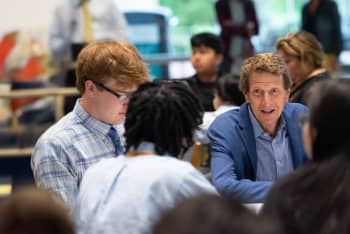
Bryant University President Ross Gittell, Ph.D.
Bryant University President Ross Gittell, Ph.D.
Throughout its 164-year history, Gittell notes, Bryant has built its reputation on real world experience and strong career outcomes, with 98 percent of the class of 2025 in grad school or jobs with a starting salary of $77,000 per year. That reputation has been sustained through changing technologies and economic transformations due to a relentless focus on student success and strong engagement with employers and corporate partners. Now, amidst one of the most rapid technological adaptations in human history, the institution has built the framework to ensure its students can thrive and lead through it.
Here’s the playbook on how Bryant is future-proofing a college degree in the AI era:
Move Beyond the Pilot Phase (and Quickly)
Across the world, colleges are determining how AI fits into teaching and learning. Institutions are launching task forces, drafting AI guidance, and testing classroom applications while grappling with questions surrounding academic integrity, governance, and faculty preparedness.
Bryant’s strategy, led by Provost and Chief Academic Officer Rupendra Paliwal, Ph.D., has been to move quickly through generative learning and informed experimentation. Over the last year, the university has launched an applied AI undergraduate major, an undergraduate minor, and a master’s degree in applied AI. Bryant has also expanded integration across all of its academic programs, including more than 20 undergraduate AI-focused courses, ensuring that every Bryant student is exposed to AI application.
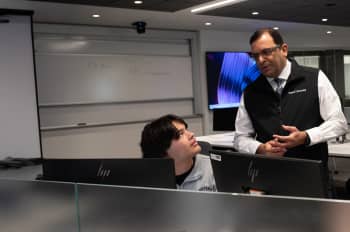
Bryant Provost and Chief Academic Officer Rupendra Paliwal, Ph.D.
Bryant Provost and Chief Academic Officer Rupendra Paliwal, Ph.D.
Paliwal cautions that higher education leaders and faculty cannot simply shoehorn AI into course catalogs but, instead, should “redesign learning around the capabilities we believe in." At Bryant, that means combining a UN Sustainable Development Goals-aligned general education curriculum, interdisciplinary experiential learning, and AI proficiency grounded in human discernment.
"If students use AI to avoid reading, writing, revising, or thinking through ambiguity, they may become faster without being wiser,” Paliwal said at Bryant’s second-annual AI Summit in May. “It is our job as educators to help them distinguish between productive cognitive offloading and cognitive surrender.”
Develop Faculty’s AI Expertise
This year’s AI Summit brought together faculty, industry experts, instructional designers, and academic leaders from across the region to explore AI’s impact on curriculum design, academic integrity, and the evolving needs of employers and society. The second-annual event expanded upon a broader university effort to create spaces where faculty can speak frankly and experiment with new approaches to pedagogy. The week prior, Bryant’s Center for Teaching Excellence (CTE) hosted its annual Teaching Summit, where faculty explored responsible AI integration across the curriculum.
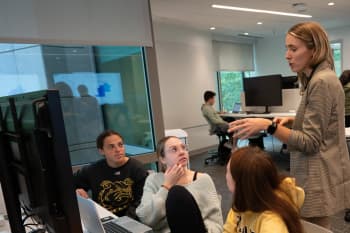
Data Scientist Geri Louise Dimas, Ph.D.
Data Scientist Geri Louise Dimas, Ph.D.
Some of the CTE’s work on AI is supported by the Davis Educational Foundation, which has funded initiatives at Bryant designed to strengthen student success and persistence through responsible generative AI implementation, including the university’s AI Faculty Fellows program.
The grant has fostered “a community of practice that empowers faculty to harness AI as a tool for inclusive, effective, and forward-thinking instruction,” says Terri Hasseler, Ph.D., dean of the university’s College of Humanities and Social Sciences.
AI Faculty Fellow Gianluca Brero, Ph.D., assistant professor of Information Systems and Analytics within Bryant’s College of Business, studies the intersection of agentic AI, market design, fairness, and ethical systems.
“The growing focus on AI safety and ethics is a source of optimism,” he says. “By embedding transparency, ethics, and accountability into AI systems, we can unlock their transformative potential, shaping a future where technology truly serves humanity.”
In courses taught by AI Faculty Fellow and Biological and Biomedical Sciences Professor Brian Blais, Ph.D., within Bryant’s College of Health and Behavioral Sciences, students use AI tools outside of class to explain concepts, generate tutorials, and create practice problems while reviewing recorded lectures at their own pace. Classroom time is then devoted to active problem-solving, experimentation, and collaboration, a “flipped” model designed to emphasize critical thinking and application over rote memorization.
Blais's approach reflects a broader shift taking place across higher education as faculty grapple with concerns regarding academic integrity and AI-assisted cheating. Rather than attempting to wall off students from the technologies they will encounter in the workplace, Bryant faculty are redesigning coursework around discussion, synthesis, experimentation, and applied problem-solving.
Faculty are also developing AI-supported learning tools intended to strengthen comprehension and student engagement. Among them is Trustee Professor of Management Michael Roberto, DBA, who launched the university’s first in a suite of AI tutors to support high-level learning and application.
Bryant’s Geri Louise Dimas, an assistant professor of Information Systems and Analytics, is supporting AI awareness and application at the high school level. This summer, Dimas — whose own research uses machine learning to identify human trafficking patterns — is hosting Bryant’s second pre-college AI and Data Science Camp, where ninth through twelfth-grade students will cover topics including generative AI, data visualization, Python programming, and more with Bryant’s faculty experts.
Build an Applied AI Ecosystem
Bryant’s AI strategy extends beyond curriculum and faculty development into industry collaboration.
Last October, the university partnered with Information Services Group (ISG), a global technology advisory firm whose research division is led by alum John Boccuzzi, Jr., to host the AI & Business Transformation Executive Roundtable, which convened business leaders, technologists, and academic experts to discuss how AI is reshaping workforce demands and organizational strategy.
Those conversations helped inform the continued expansion of Bryant’s Center for Applied Artificial Intelligence and the launch of the university’s Hauck AI Performance Labs, which will serve as secure AI sandboxes where students, faculty, staff, and industry partners can prototype and test AI solutions using enterprise-grade systems and datasets.
For learners across the lifespan, Bryant’s new stackable Applied AI Academy was built to provide practical, applied AI training for working professionals, employer partners, and Rhode Island workforce development audiences.
Bryant student Quinn Arnold has developed several AI-powered apps.
Bryant student Quinn Arnold has developed several AI-powered apps.
Shift from Classroom Learning to Real-World Solutions
Across majors, Bryant students are encouraged to apply AI to real-world challenges with tangible social and professional impact. For Applied Mathematics and Statistics major Quinn Arnold ’26, that meant developing SafeWalk AI, a predictive navigation app that identifies safe walking routes; a pain-tracking app, which was inspired by his own chronic illness; and one that supports small-business entrepreneurs.
At the AI Summit, Arnold spoke about the impact of AI on his educational journey.
“I learned through experience,” says Arnold. “Anybody has the capability to build anything, in this day and age.”
Arnold’s work mirrors Bryant’s broader philosophy toward AI and education: Over the course of their time in college, students will develop a mastery of emerging technologies. But they must also learn how to apply those technologies to complex human challenges using judgement and leadership.
Bryant's AI momentum is a product of intentional investments in curriculum, faculty development, industry partnerships, and experiential learning. It is also guided by a conviction that the future belongs to institutions willing to build the systems, culture, and experiences required for an AI-transformed economy. Bryant’s faculty, staff, and students are deeply engaged in AI integration: not waiting, but learning and leading.
This custom content is sponsored by Bryant University and developed by Inside Higher Ed's sponsored content team. The editorial staff of Inside Higher Ed had no role in its creation.
 Built with Shorthand