

Indiana University Improving Lives With Empathy
IU’s strengths and resources in the humanities help faculty create human-centered solutions at home and across the globe.
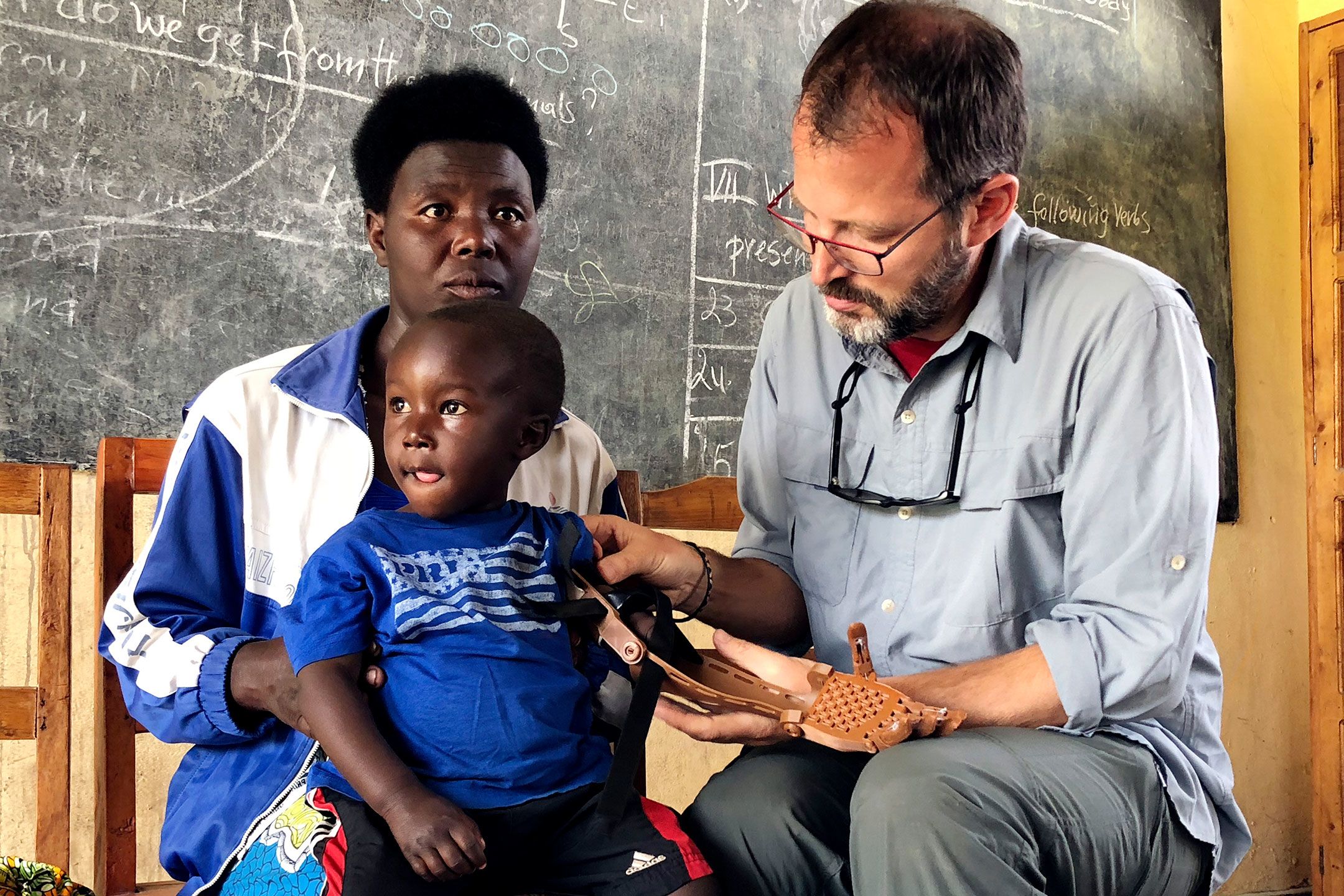

An effort now changing lives in Africa started with a 9-year-old girl in Indiana University Bloomington’s backyard — a girl named Violet who was born without part of her right arm.
Violet wanted a prosthesis so she could play a musical instrument, more easily ride a bike and do the other things that help 9-year-old girls feel like they belong.
Jonathan Racek found out about Violet's wish and immediately got to work.
Racek is program director of comprehensive design in the Eskenazi School of Art, Architecture + Design at IU Bloomington. With the help of his students and the school’s fabrication lab, Racek built a customized 3D-printed arm that opened up the world for Violet.
Based on the success he had with Violet’s prosthesis, Racek began to think about how to expand his efforts globally to help other children live their dreams. That turned into a partnership with a school in Rwanda, where he has created prosthetic arms for children.
“This initiative combined advanced technology with a deeply personal, human impact,” he said. “We were able to affordably create customized prosthetic limbs for children who would otherwise not have access to this technology. Seeing the transformation in their mobility was one of the most rewarding moments of my career.”
Racek’s work with Violet and now the people of Rwanda is just one example of how IU’s faculty and students are applying their research knowledge and impact to better lives.
“Indiana University provides a fertile ground for creative problem-solving by offering access to state-of-the-art technology, a culture of interdisciplinary collaboration and a supportive environment for experimentation,” Racek said. “The university fosters a mindset that encourages students and faculty alike to consider how their skills and knowledge can address real-world challenges.”

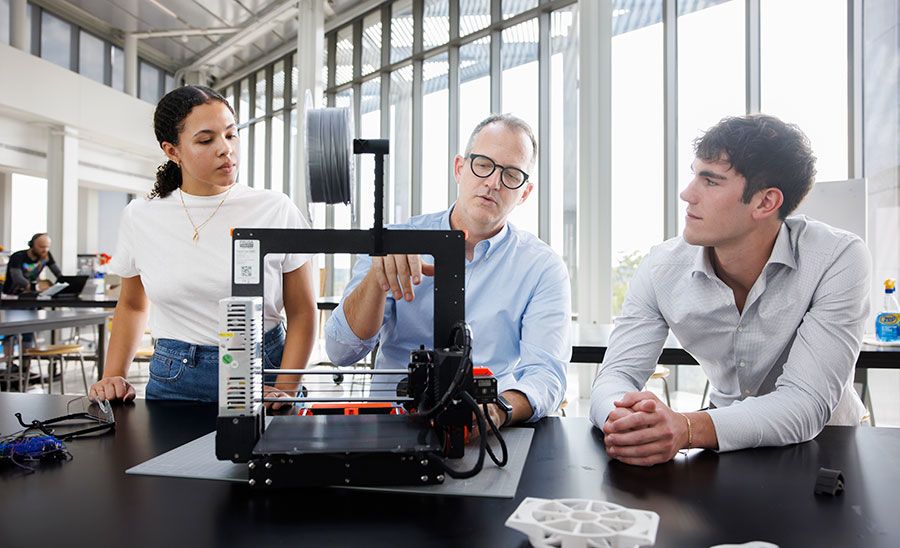
That’s part of what drew Racek to IU. He previously served as the founder and principal of Stew Design Workshop, an architectural and furniture design firm. His work was exhibited all over the world, even appearing in The New York Times and Time magazine. But he questioned its impact.
"I wanted my work to have a more tangible, positive effect on people’s lives," he said. "I realized that creating beautiful objects, while something I still enjoy, wasn't enough for my career."
Racek left the company to found Play360, a nonprofit that trains nongovernmental organizations to build low-cost educational resources in developing countries. To date, Play360 has built more than 200 playgrounds in 20 countries.
It was soon after he launched Play360 that Racek joined IU.
Since then, Racek helped launch the United States chapter of MyMachine Global, an international network of educators and partners that encourages students of all ages to dream big and reach for those dreams as if failure were not a possibility.
MyMachine USA invites elementary school students to dream up ideas for machines. Then, Racek’s students at IU Bloomington develop those dreams into formalized concepts. From there, high school students create the finished product, which is delivered back to the elementary school students for their review.
At IU, Racek's goal is to teach students how to create design solutions that focus first on people. Sometimes that looks like a library. Other times it could be a new water filter. And sometimes, like in Rwanda, it looks like a partnership where Racek provided a 3D printer to create essential items like protractors or building blocks.
The one constant is that the process always starts by uncovering real-life pain points for potential end users, part of a principle called human-centered design.
“It’s about asking the right questions,” Racek said. “How do people interact with this space or product? What challenges do they face, and how can design alleviate or improve those challenges? Design is not done in a vacuum; it is informed by real people and their actual needs.”
Human-centered approach drives holistic solutions
Emily Beckman shares Racek’s mindset. Beckman is director of the Medical Humanities and Health Studies program in the IU School of Liberal Arts in Indianapolis. Like Racek, her efforts are born from a desire to create a better world, teaching IU students who will go on to become doctors and other healthcare professionals about the importance of empathy in patient care.
Beckman’s message in the classroom is clear: Patients are more than chest X-rays and white blood cell counts; they are humans, placing trust in medical professionals to ease their suffering.
“Medical humanities encourages students to think beyond the checklist of symptoms or the diagnosis or the prescription and connect with that person,” Beckman said. “It really strengthens that part of our brains that then allows us to better identify with patients when they are most vulnerable.”
In May 2024, Beckman was awarded the Indiana University Presidential Arts and Humanities Fellowship, which provides support to innovative research and creative projects which have the potential for societal impact.
Beckman established the nonprofit organization, Build Community Give Care, which addresses health disparities in western and sub-Saharan Africa.
One of those disparities lies in palliative care. The nonprofit partnered with Hospice Africa Uganda, which trains health care workers to improve end-of-life care.
“In Uganda and much of Africa, far too many people are experiencing severe pain with serious illness at the end of life, and they end up dying without specialized care,” Beckman said. “There are nurses and social workers who want that training, but it costs too much.”
With fellowship funding, Beckman and volunteers recently went to Uganda and met with those in charge of palliative care to learn first-hand about the obstacles to improved patient services.
“I was particularly struck by hearing how these health care workers think about palliative care as such a holistic form of care and then seeing that in practice,” she said. “We observed a nurse caring for a patient, and she spent more time simply listening to him talk about his psychosocial and spiritual situation than his physical situation.”
The physical situation was straightforward: He was dying. He was in pain. He needed pain medication. But, Beckman said, witnessing the nurse give so much attention to the other aspects of his end-of-life journey was inspiring.
Light-bulb moments matter most
Much like Beckman and Racek, faculty and students across IU are using the arts and humanities to create more compassionate solutions to issues that affect communities far and wide.
“IU’s resources have been instrumental in turning ambitious visions into practical realities,” Racek said. “IU’s emphasis on collaboration across different fields — whether it’s business, technology or social sciences — allows for a broader, more holistic approach to solving complex problems.”
Beckman said her best experiences have come from seeing medical students use the humanities to find new ways to think about the world.
“These are some of the top students in the country,” Beckman said. “To see the light go on and that moment of ‘Wow, I’ve never thought of these things in this way before’ — those little light-bulb moments are what I find so rewarding.”

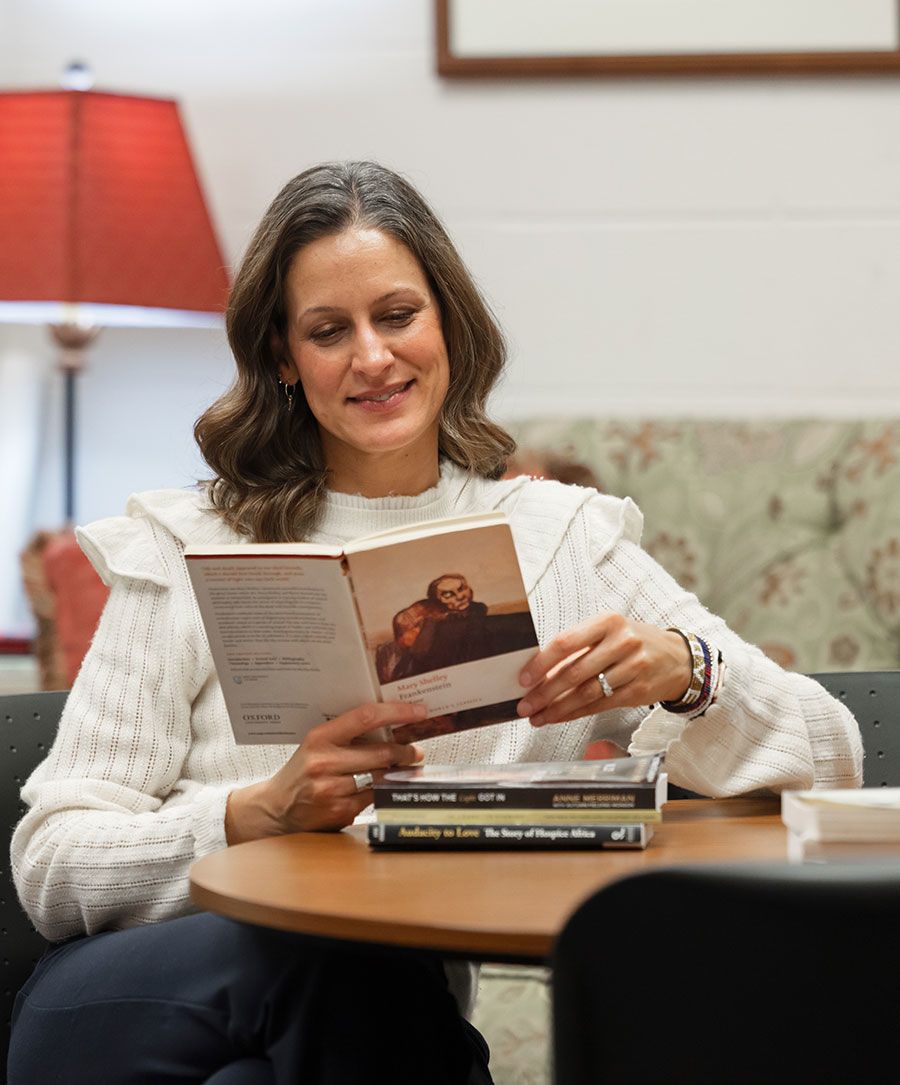
Emily Beckman, Director of the Medical Humanities and Health Studies program
Emily Beckman, Director of the Medical Humanities and Health Studies program

Human-centered approach drives holistic solutions
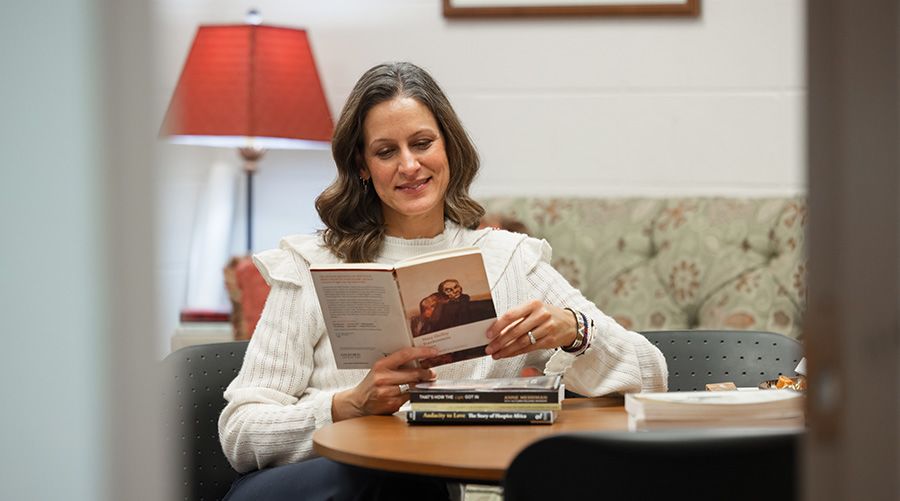
Emily Beckman shares Racek’s mindset. Beckman is director of the Medical Humanities and Health Studies program in the IU School of Liberal Arts in Indianapolis. Like Racek, her efforts are born from a desire to create a better world, teaching IU students who will go on to become doctors and other healthcare professionals about the importance of empathy in patient care.
Beckman’s message in the classroom is clear: Patients are more than chest X-rays and white blood cell counts; they are humans, placing trust in medical professionals to ease their suffering.
“Medical humanities encourages students to think beyond the checklist of symptoms or the diagnosis or the prescription and connect with that person,” Beckman said. “It really strengthens that part of our brains that then allows us to better identify with patients when they are most vulnerable.”
In May 2024, Beckman was awarded the Indiana University Presidential Arts and Humanities Fellowship, which provides support to innovative research and creative projects which have the potential for societal impact.
Beckman established the nonprofit organization, Build Community Give Care, which addresses health disparities in western and sub-Saharan Africa.
One of those disparities lies in palliative care. The nonprofit partnered with Hospice Africa Uganda, which trains health care workers to improve end-of-life care.
“In Uganda and much of Africa, far too many people are experiencing severe pain with serious illness at the end of life, and they end up dying without specialized care,” Beckman said. “There are nurses and social workers who want that training, but it costs too much.”
With fellowship funding, Beckman and volunteers recently went to Uganda and met with those in charge of palliative care to learn first-hand about the obstacles to improved patient services.
“I was particularly struck by hearing how these health care workers think about palliative care as such a holistic form of care and then seeing that in practice,” she said. “We observed a nurse caring for a patient, and she spent more time simply listening to him talk about his psychosocial and spiritual situation than his physical situation.”
The physical situation was straightforward: He was dying. He was in pain. He needed pain medication. But, Beckman said, witnessing the nurse give so much attention to the other aspects of his end-of-life journey was inspiring.
Light-bulb moments matter most
Much like Beckman and Racek, faculty and students across IU are using the arts and humanities to create more compassionate solutions to issues that affect communities far and wide.
“IU’s resources have been instrumental in turning ambitious visions into practical realities,” Racek said. “IU’s emphasis on collaboration across different fields — whether it’s business, technology or social sciences — allows for a broader, more holistic approach to solving complex problems.”
Beckman said her best experiences have come from seeing medical students use the humanities to find new ways to think about the world.
“These are some of the top students in the country,” Beckman said. “To see the light go on and that moment of ‘Wow, I’ve never thought of these things in this way before’ — those little light-bulb moments are what I find so rewarding.”
This content is sponsored and provided by Indiana University and developed by Inside Higher Ed's sponsored content team. The editorial staff of Inside Higher Ed had no role in its creation.


 Built with Shorthand