

Thomas Jefferson University
Preparing Leaders for the Future of Work


Thomas Jefferson University
Preparing Leaders for the Future of Work
The goals of professions-focused higher education have long been clear: First, enabling university graduates to master the existing discipline-specific knowledge and skills needed for them to succeed in their chosen careers. Second, encouraging them to help push their professions forward by developing new knowledge about their fields and pioneering more effective ways of practicing.
“Today, those are still our primary goals,” explains Susan Aldridge, PhD, President of Thomas Jefferson University. “But the extraordinary speed and impact of technological, economic and cultural change — which only seems to be getting faster with each passing month — has meant a tectonic shift in what terms such as ‘mastery’ and ‘success’ will mean for graduates in coming years and decades. That shift will affect the range and types of knowledge and skills needed for professional practice in this century. Indeed, history tells us that entire professional fields won’t exist anymore, while new professions and career tracks emerge and flourish.”
This reality has caught hundreds of colleges and universities behind the curve, scrambling to adapt, and seeking a path forward. For many of them, this is an existential challenge. Their institutions’ continued relevance and viability rely on demonstrating the value of the education they are offering students whose success will depend on their ability to surf the waves of change.


Thomas Jefferson University is a notable exception. “We are an institution with 200 years’ experience in pioneering professions-focused higher education,” Aldridge notes. “Our faculty, students and alumni have long viewed technological and societal changes as both practical challenges and unique opportunities.” From the University’s founding, it has met those challenges and leveraged those opportunities to graduate leaders in their fields. Just a few examples: In 1824, Jefferson established one of the nation’s first medical schools and the first clinic for the poor. In the 19th and 20th centuries, it created pioneering education and research programs in textiles science — helping establish major industrial sectors and professions — and created one of today’s leading programs in fashion design. Now, in this dynamic century, Jefferson’s approach to teaching and learning provides graduates with a powerful blend of disciplinary knowledge, personal skills (in collaboration, communication, innovation, and cross-cultural engagement), and hands-on experience working on the kind of concrete projects they will encounter in their professions.
Demonstrating Value
Said differently, the need to anticipate the “future of work” and address the implications of dynamic change is nothing new to Jefferson. That’s reflected in real results, such as Jefferson students’ immediate and ongoing success. Year after year, its graduates have had at least a 95 percent rate of success in finding work or entering graduate school in their fields within a year of completing their degrees. Employers find these young professionals are prepared to contribute immediately — bringing a depth of knowledge, creativity, entrepreneurial spirit and problem-solving skills that are increasingly hard to find. Over time, employers realize another fact about Jefferson graduates: They recognize the value of life-long learning and are capable of driving their own professional and personal development.
"We're preparing them to succeed throughout their professional careers; enabling them to adapt to change and relish the opportunities created," Aldridge explains.
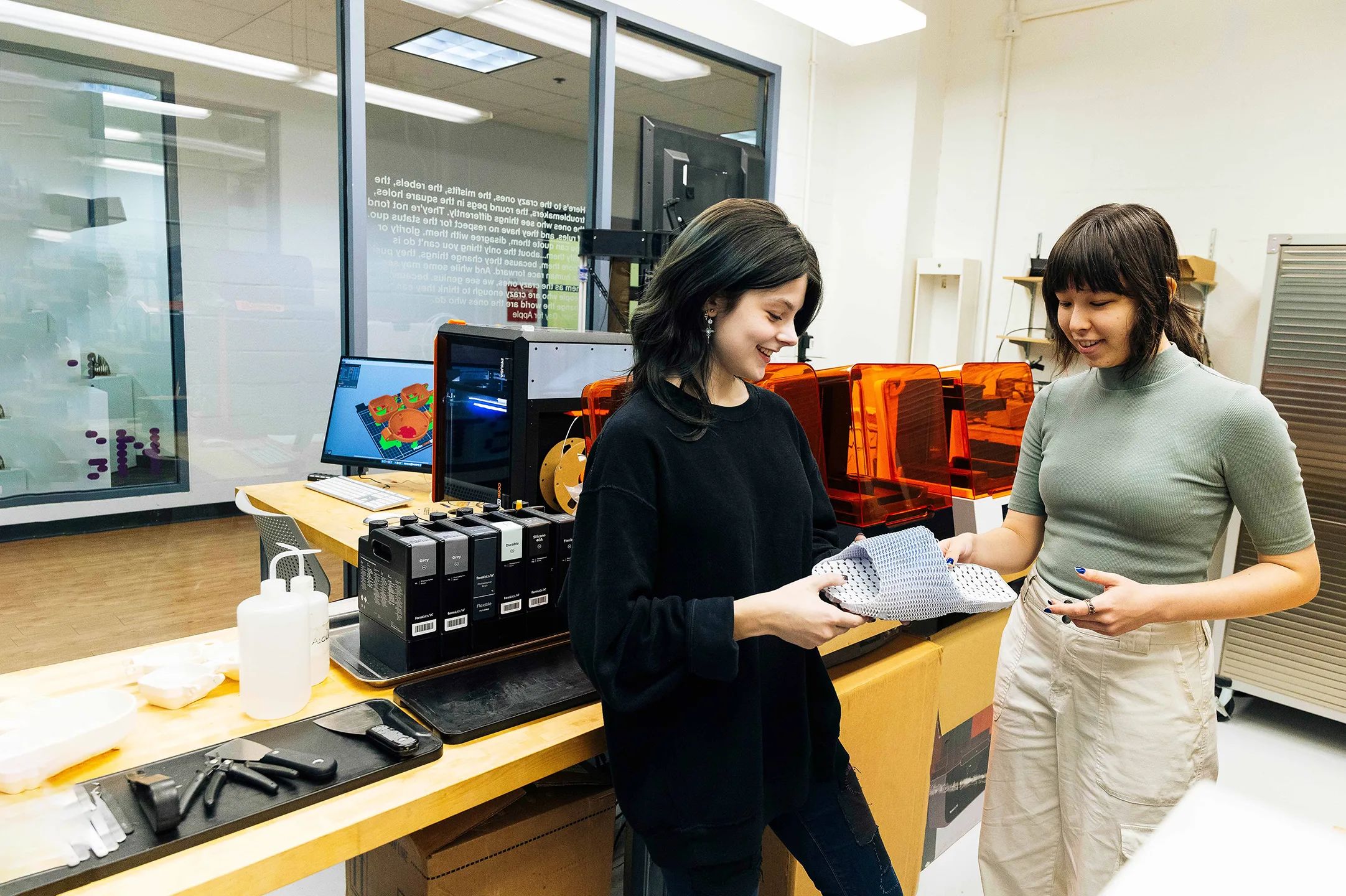
Jefferson’s success is also reflected in an increase in admissions and in the launch of more than two dozen academic programs. For example, its programs in Sustainable Design, Fashion Design and Industrial Design have been widely recognized for training leading designers, enabling them to use data-driven and simulation-based tools to address climate change, population growth, public health and resource depletion.



Expanding the Role of AI
Of course, one of the biggest challenges facing both universities and their students is the changes and opportunities presented by artificial intelligence. For Aldridge, who previously served as President of the University of Maryland Global Campus and President of Drexel University Online, AI is the latest major challenge arising from emerging digital and computational technologies. But she recognizes its potential to have a far deeper impact on the nature of work than did the preceding developments.
“Universities cannot approach AI as a series of discrete problems to be solved,” Aldridge says, “nor prepare our students in that way. AI’s implications are myriad and intersecting; its development is moving too fast.” Thus, Jefferson is addressing AI in a multifaceted way. For example, faculty are integrating AI capacities into their basic pedagogies and using it to develop whole new ways of teaching groups and individuals. “I am especially optimistic about using AI to tailor teaching and learning approaches to each student’s specific needs, interests and strengths,” she notes.
Jefferson faculty across the institution are adapting curriculum to help students to both use and collaborate with AI. The goal: Enable students to both be comfortable using AI and capable of bringing empathy, insight and creativity to bear in using those technologies. In other words, encouraging students to leverage AI capacities while recognizing its limitations.
Jefferson is also creating new AI-oriented curriculum and academic programs. For example, a series of modules begin with subjects such as AI terminology, large language models, and prompt engineering; and will be expanded to create opportunities for students to tailor their AI-focused learning for their specific interests and career track.
This year, Jefferson launched four new degree programs in AI and analytics. Two are broad based in applicability: The Business Analytics program enables students to excel at data storytelling, while the Data Analytics program offers a deeper dive into the technical world of data analysis, algorithms and machine learning. And two focus on biomedicine and healthcare: The Computational Biology and Medicine program focuses on techniques to analyze biological data, understand complex biological systems and improve patient outcomes, while the Artificial Intelligence in Health Analytics Leadership program offers practical skills and expertise in AI implementation, leveraging data in novel ways, and improving tracking of patient outcomes. A new Health Artificial Intelligence program will launch later in 2026.
“I really believe that throughout its history Thomas Jefferson University has done a tremendous job of recognizing emerging change and then doing what’s necessary to ensure its graduates are prepared for both present and emerging-future challenges,” Aldridge says. “That’s especially important today: We must ensure that we’re preparing tomorrow’s leaders to see, understand and respond to the dynamic changes our world will experience in this century.”


The goals of professions-focused higher education have long been clear: First, enabling university graduates to master the existing discipline-specific knowledge and skills needed for them to succeed in their chosen careers. Second, encouraging them to help push their professions forward by developing new knowledge about their fields and pioneering more effective ways of practicing.
“Today, those are still our primary goals,” explains Susan Aldridge, PhD, President of Thomas Jefferson University. “But the extraordinary speed and impact of technological, economic and cultural change — which only seems to be getting faster with each passing month — has meant a tectonic shift in what terms such as ‘mastery’ and ‘success’ will mean for graduates in coming years and decades. That shift will affect the range and types of knowledge and skills needed for professional practice in this century. Indeed, history tells us that entire professional fields won’t exist anymore, while new professions and career tracks emerge and flourish.”
This reality has caught hundreds of colleges and universities behind the curve, scrambling to adapt, and seeking a path forward. For many of them, this is an existential challenge. Their institutions’ continued relevance and viability rely on demonstrating the value of the education they are offering students whose success will depend on their ability to surf the waves of change.
Thomas Jefferson University is a notable exception. “We are an institution with 200 years’ experience in pioneering professions-focused higher education,” Aldridge notes. “Our faculty, students and alumni have long viewed technological and societal changes as both practical challenges and unique opportunities.” From the University’s founding, it has met those challenges and leveraged those opportunities to graduate leaders in their fields. Just a few examples: In 1824, Jefferson established one of the nation’s first medical schools and the first clinic for the poor. In the 19th and 20th centuries, it created pioneering education and research programs in textiles science — helping establish major industrial sectors and professions — and created one of today’s leading programs in fashion design. Now, in this dynamic century, Jefferson’s approach to teaching and learning provides graduates with a powerful blend of disciplinary knowledge, personal skills (in collaboration, communication, innovation, and cross-cultural engagement), and hands-on experience working on the kind of concrete projects they will encounter in their professions.


Demonstrating Value
Said differently, the need to anticipate the “future of work” and address the implications of dynamic change is nothing new to Jefferson. That’s reflected in real results, such as Jefferson students’ immediate and ongoing success. Year after year, its graduates have had at least a 95 percent rate of success in finding work or entering graduate school in their fields within a year of completing their degrees. Employers find these young professionals are prepared to contribute immediately — bringing a depth of knowledge, creativity, entrepreneurial spirit and problem-solving skills that are increasingly hard to find. Over time, employers realize another fact about Jefferson graduates: They recognize the value of life-long learning and are capable of driving their own professional and personal development.
"We're preparing them to succeed throughout their professional careers; enabling them to adapt to change and relish the opportunities created," Aldridge explains.
Jefferson’s success is also reflected in an increase in admissions and in the launch of more than two dozen academic programs. For example, its programs in Sustainable Design, Fashion Design and Industrial Design have been widely recognized for training leading designers, enabling them to use data-driven and simulation-based tools to address climate change, population growth, public health and resource depletion.


Expanding the Role of AI
Of course, one of the biggest challenges facing both universities and their students is the changes and opportunities presented by artificial intelligence. For Aldridge, who previously served as President of the University of Maryland Global Campus and President of Drexel University Online, AI is the latest major challenge arising from emerging digital and computational technologies. But she recognizes its potential to have a far deeper impact on the nature of work than did the preceding developments.
“Universities cannot approach AI as a series of discrete problems to be solved,” Aldridge says, “nor prepare our students in that way. AI’s implications are myriad and intersecting; its development is moving too fast.” Thus, Jefferson is addressing AI in a multifaceted way. For example, faculty are integrating AI capacities into their basic pedagogies and using it to develop whole new ways of teaching groups and individuals. “I am especially optimistic about using AI to tailor teaching and learning approaches to each student’s specific needs, interests and strengths,” she notes.


Jefferson faculty across the institution are adapting curriculum to help students to both use and collaborate with AI. The goal: Enable students to both be comfortable using AI and capable of bringing empathy, insight and creativity to bear in using those technologies. In other words, encouraging students to leverage AI capacities while recognizing its limitations.
Jefferson is also creating new AI-oriented curriculum and academic programs. For example, a series of modules begin with subjects such as AI terminology, large language models, and prompt engineering; and will be expanded to create opportunities for students to tailor their AI-focused learning for their specific interests and career track.


This year, Jefferson launched four new degree programs in AI and analytics. Two are broad based in applicability: The Business Analytics program enables students to excel at data storytelling, while the Data Analytics program offers a deeper dive into the technical world of data analysis, algorithms and machine learning. And two focus on biomedicine and healthcare: The Computational Biology and Medicine program focuses on techniques to analyze biological data, understand complex biological systems and improve patient outcomes, while the Artificial Intelligence in Health Analytics Leadership program offers practical skills and expertise in AI implementation, leveraging data in novel ways, and improving tracking of patient outcomes. A new Health Artificial Intelligence program will launch later in 2026.
“I really believe that throughout its history Thomas Jefferson University has done a tremendous job of recognizing emerging change and then doing what’s necessary to ensure its graduates are prepared for both present and emerging-future challenges,” Aldridge says. “That’s especially important today: We must ensure that we’re preparing tomorrow’s leaders to see, understand and respond to the dynamic changes our world will experience in this century.”
This content is sponsored and provided by Thomas Jefferson University and developed by Inside Higher Ed's sponsored content team. The editorial staff of Inside Higher Ed had no role in its creation.


This content is sponsored and provided by Thomas Jefferson University and developed by Inside Higher Ed's sponsored content team. The editorial staff of Inside Higher Ed had no role in its creation.
 Built with Shorthand