

Creating a national sandbox
How the University of Arkansas’ MUSiC facility is bridging silicon carbide research and commercial output

Creating a national sandbox
Silicon powers the modern global economy. Forming the bedrock of the computer chip industry, it is fundamental to digital transformation across a wide range of sectors. However, as the demand for higher performance computing, ever-faster speeds and smaller devices grows, the limitations of traditional silicon have become apparent.
Alan Mantooth, distinguished professor of engineering and founding director of the UA Power Group at the University of Arkansas, explains how the institution, including its Multi-User Silicon Carbide (MUSiC) Research and Fabrication Facility, is pioneering work on silicon carbide (SiC) that emphasises the material’s importance in high-voltage, high-frequency and high-temperature environments where conventional silicon can fall short.
“The MUSiC facility addresses a critical gap in U.S. production regarding integrated circuits made with silicon carbide,” Mantooth says. “We are making things possible that simply aren't feasible today with standard silicon. Silicon carbide can survive in harsh environments where silicon fails.”


Alan Mantooth, the UA Power Group’s founding director and Distinguished Professor of Engineering. Image credit: Whit Pruitt
Alan Mantooth, the UA Power Group’s founding director and Distinguished Professor of Engineering. Image credit: Whit Pruitt
Silicon powers the modern global economy. Forming the bedrock of the computer chip industry, it is fundamental to digital transformation across a wide range of sectors. However, as the demand for higher performance computing, ever-faster speeds and smaller devices grows, the limitations of traditional silicon have become apparent.
Alan Mantooth, distinguished professor of engineering and founding director of the UA Power Group at the University of Arkansas, explains how the institution, including its Multi-User Silicon Carbide (MUSiC) Research and Fabrication Facility, is pioneering work on silicon carbide (SiC) that emphasises the material’s importance in high-voltage, high-frequency and high-temperature environments where conventional silicon can fall short.

Alan Mantooth, the UA Power Group’s founding director and Distinguished Professor of Engineering. Image credit: Whit Pruitt
Alan Mantooth, the UA Power Group’s founding director and Distinguished Professor of Engineering. Image credit: Whit Pruitt
“The MUSiC facility addresses a critical gap in U.S. production regarding integrated circuits made with silicon carbide,” Mantooth says. “We are making things possible that simply aren't feasible today with standard silicon. Silicon carbide can survive in harsh environments where silicon fails.”
Making MUSiC: Powering the Future of Semiconductors
Inside the University of Arkansas’s Multi-User Silicon Carbide Facility (MUSiC), the nation’s only openly accessible silicon carbide fabrication facility, researchers, students and industry partners are designing, prototyping and testing the next generation of semiconductor technology.


Making MUSiC: Powering the Future of Semiconductors
Inside the University of Arkansas’s Multi-User Silicon Carbide Facility (MUSiC), the nation’s only openly accessible silicon carbide fabrication facility, researchers, students and industry partners are designing, prototyping and testing the next generation of semiconductor technology.
These environments include those involving high-temperature applications, such as energy exploration and generation. Whether the environment is high-temperature, high-pressure or corrosive, silicon carbide can survive where silicon cannot, bringing many large-scale commercial opportunities to the fore.
“MUSiC provides a bridge to high-volume manufacturing,” Mantooth says. “For silicon carbide, there is almost no excess capacity for pre-commercial prototyping. But MUSiC serves as a national sandbox. It’s a fabrication facility built at scale with the process control of a professional foundry. It allows clients to take their results to investors with the data proving that they are ready to scale.”
As the only openly accessible facility of its kind, MUSiC accelerates innovation, allowing individuals to turn their ideas into reality and achieve fast turnaround. “By the time a client finishes with us, they have essentially eliminated the need to redo the prototyping and development process with a major foundry because we work so closely with them,” Mantooth says. “And because we are a non-profit, we can lower the finances needed to go commercial.”


The grand opening of the MUSiC facility in November 2025. Image credit: Russell Cothren
The grand opening of the MUSiC facility in November 2025. Image credit: Russell Cothren


Kim Needy, Dean of the U of A’s College of Engineering. Image credit: Chieko Hara
Kim Needy, Dean of the U of A’s College of Engineering. Image credit: Chieko Hara

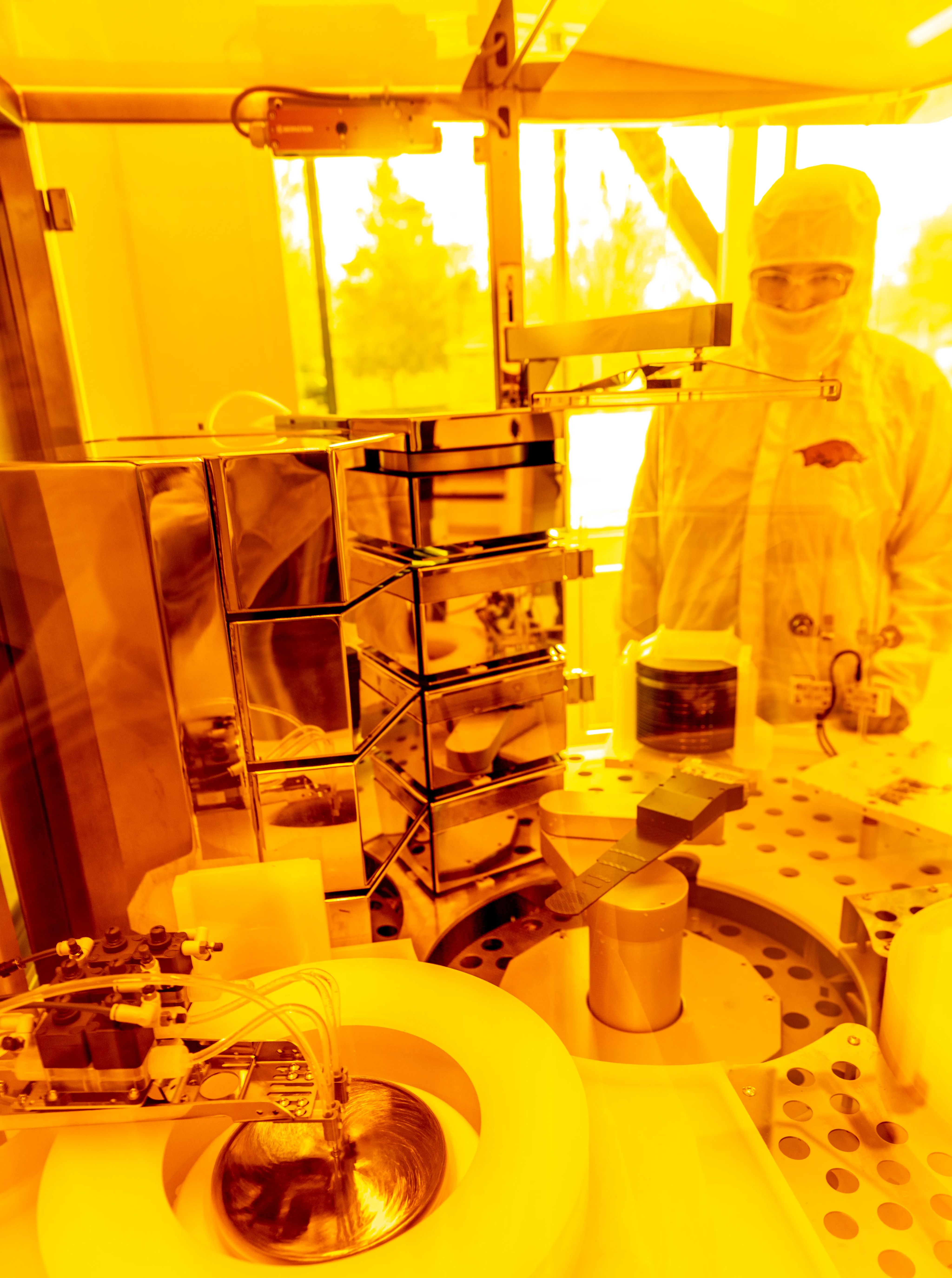
Researcher observing automated chemical dispensing in a photolithography bay. Image credit: Russell Cothren
Researcher observing automated chemical dispensing in a photolithography bay. Image credit: Russell Cothren

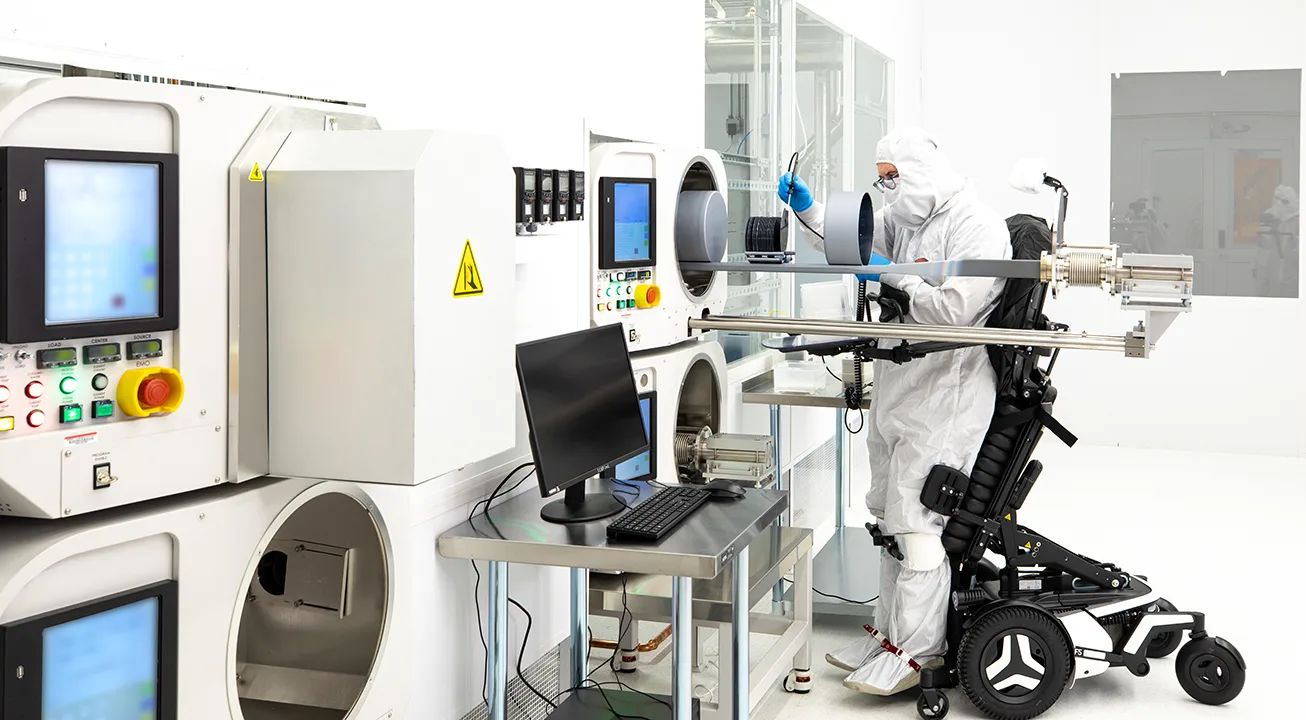
Clean room bay with four horizontal furnaces capable of depositing various thin films on wafers. Image credit: Russell Cothren
Clean room bay with four horizontal furnaces capable of depositing various thin films on wafers. Image credit: Russell Cothren
Some of the sectors that depend on SiC electronics include transportation – particularly electric vehicles – and data centers, something that is set to become increasingly important as the rise of AI continues. By pioneering SiC research, the University of Arkansas also hopes to cement its own position as a leader in training the next generation of engineers.
“MUSiC solidifies the University of Arkansas as a leading national training ground for semiconductor engineers and researchers,” says Kim Needy, dean of the College of Engineering at the University of Arkansas. “By providing our students and faculty with direct access to advanced fabrication, packaging and testing environments, we are preparing the workforce that will lead America’s semiconductor renaissance. This facility embodies our mission to educate, innovate and collaborate at the highest levels – right here in Arkansas.”
Distinguished Professor Alan Mantooth defines semiconductors and discusses why the University of Arkansas is uniquely positioned to be a semiconductor research and fabrication hub in the heartland of the United States.
Both workforce development and public transparency are vital components at MUSiC and will continue to be so as further SiC applications are developed. “Unlike Intel or Texas Instruments, at MUSiC, you can see right inside the fabrication facility,” Mantooth notes. “You can walk up, scan a QR code and learn what photolithography is in terms that an eighth grader can understand. But more than that, we are building a holistic workforce pipeline, training both non-college-bound and college-bound individuals. We are even looking at ways to gamify the experience so students from any economic background can log in at a public library and learn how things work in a fabrication facility.”
Find out more about silicon carbide research at the University of Arkansas.
This content is sponsored by University of Arkansas and developed by Inside Higher Ed's sponsored content team. The editorial staff of Inside Higher Ed had no role in its creation.


 Built with Shorthand