
Modular shoreline protection system offers new defense for vulnerable coastlines
With 3 billion people living near at-risk coastlines, the University of Miami's concrete hexagons may hold the answer for securing the future of coastal communities
Content sponsored and provided by the University of Miami
Modular shoreline protection system offers new defense for vulnerable coastlines
With 3 billion people living near at-risk coastlines, the University of Miami's concrete hexagons may hold the answer for securing the future of coastal communities
Content sponsored and provided by the University of Miami
Globally, around 40 percent of the world’s population lives near the coast – more than 3 billion people, according to data from the United Nations. As populations grow and increasing numbers move to coastal cities, this rapid urbanization – alongside the impact of climate collapse – will not come without costs and risks. In densely populated areas such as South Florida, a high proportion of land is located in low-elevation coastal zones, meaning its communities and the built environment are vulnerable to flooding and storm surges.
Responding to this complex issue, the University of Miami has developed an innovative shoreline protection system designed to reduce wave energy and restore marine habitats in coastal environments. The SEAHIVE® system is made up of modular, hexagonal concrete units that can be arranged along shorelines. Water flows through the system, allowing wave energy to dissipate before it reaches the coast. The structure creates space for corals, mangroves and other marine organisms to grow, helping to rebuild the natural features that once protected coastlines. Crucially, the system can dissipate wave energy as it comes in, differentiating it from other shoreline protection systems.
Landolf Rhode-Barbarigos, associate professor, Department of Civil and Architectural Engineering at the University of Miami
Landolf Rhode-Barbarigos, associate professor, Department of Civil and Architectural Engineering at the University of Miami
Globally, around 40 percent of the world’s population lives near the coast – more than 3 billion people, according to data from the United Nations. As populations grow and increasing numbers move to coastal cities, this rapid urbanization – alongside the impact of climate collapse – will not come without costs and risks. In densely populated areas such as South Florida, a high proportion of land is located in low-elevation coastal zones, meaning its communities and the built environment are vulnerable to flooding and storm surges.
Responding to this complex issue, the University of Miami has developed an innovative shoreline protection system designed to reduce wave energy and restore marine habitats in coastal environments. The SEAHIVE® system is made up of modular, hexagonal concrete units that can be arranged along shorelines. Water flows through the system, allowing wave energy to dissipate before it reaches the coast. The structure creates space for corals, mangroves and other marine organisms to grow, helping to rebuild the natural features that once protected coastlines. Crucially, the system can dissipate wave energy as it comes in, differentiating it from other shoreline protection systems.
Landolf Rhode-Barbarigos, associate professor, Department of Civil and Architectural Engineering at the University of Miami
Landolf Rhode-Barbarigos, associate professor, Department of Civil and Architectural Engineering at the University of Miami
“We want to protect the built environment and communities but minimize the impact on the natural environment at the same time,” explains Landolf Rhode-Barbarigos, an associate professor in the Department of Civil and Architectural Engineering at the University of Miami. The modules can be stacked horizontally or vertically, and they are porous so water can flow through the system. “The hexagonal shape means we can construct continuous tiling and the structures are stable. And on days when the waves are not so strong, the water simply runs through them, and they are a habitat for marine life. We wanted a system that is versatile and tuned into those different conditions,” he adds.
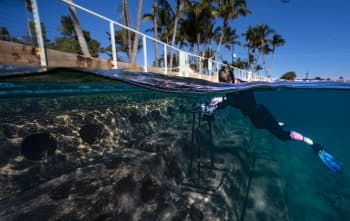
The SEAHIVE system is a prime example of how the University of Miami supports interdisciplinary collaboration and effective partnerships with stakeholders. Working with the National Cooperative Highway Research Program and the Florida Department of Transportation, Rhode-Barbarigos and his team were tasked with finding a sustainable and ecofriendly intervention to shoreline protection. Working in partnership with local government and other community organizations means the structures can be tested in the real-world as well as the lab. Initially, the team tested different shapes and porosities in the Alfred C. Glassell, Jr. SUSTAIN Laboratory, using the wind-wave flume to generate hurricane conditions. This helped them understand how the structures would interact with waves, so having a platform to conduct such pilots was essential. “We live in a region that is under pressure from the environment and a community that welcomes and receives solutions, so we worked with them on pilots. In the lab the conditions are controlled so having a real pilot is pivotal,” Rhode-Barbarigos says.
The pilots were partially financed by the University of Miami Laboratory for Integrative Knowledge (U-LINK), which supports interdisciplinary innovation projects solving a wide range of problems. As well as SEAHIVE, U-LINK has supported a number of complex research projects including how augmented reality can support behavioral analysis, technology for mood regulation and countering online extremist conspiracy theories. Having a supportive infrastructure and umbrella units like the Climate Resilience Institute is a gamechanger, argues Rhode-Barbarigos. In the SEAHIVE project, ecological expertise on coral reefs and mangroves combines with engineering, and the result shows how working together can be greater than the sum of the parts.
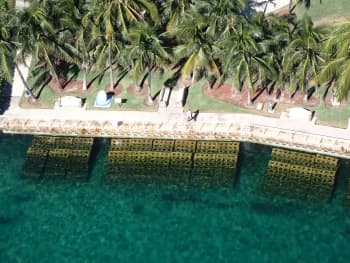
So far, the university has led two trials in Florida. The first, partially supported by the City of Miami Beach, is located offshore of Miami Beach, where three SEAHIVE stacks have been deployed and populated with corals. The second, at Pompano Beach, is a collaboration with nonprofit organization Shipwreck Park, the City of Pompano and Broward County to create a public marine education park that aims to inspire ocean literacy through immersive learning and community conservation. The results show that the structures are having a positive impact on marine life. At Miami Beach, where around 500 corals were transplanted, around 45 percent have survived despite rising temperatures and the high concentration of coral competitors. Being able to scale up installations would show even better results, Rhode-Barbarigos says, and confidence is growing thanks to these successful proofs of concept.
South Florida provides a unique location for a living laboratory. The university can engage directly with stakeholders in the community, who are the people most affected by coastal erosion and storm surges. “We get feedback from them, we co-design with the community and with local industry,” Rhode-Barbarigos says. “There is demand for engineers and ecologists and they are both building confidence in each other’s ideas. This is a location where we can promote this solution to the rest of the world.”
The introduction and re-introduction of mangroves and corals to the shoreline is equally important as these two ecosystems are in decline. “When we design the system, we actively think about how can we work with nature, how we support active restoration,” continues Rhode-Barbarigos. Working with partners and ecologists has helped the university ensure that SEAHIVE structures are situated in locations where they can help marine life to develop naturally. Every pilot generates new learnings: “We can test things in a lab but the world outside is a lot more complex and diverse. Every time we do something we learn a lot, even if we go back to the drawing board.”
Crucially, the project is developing the next generation of engineers and scientists dealing with complex challenges. “The future is interdisciplinary and we embrace that at the University of Miami. The success goes beyond that of SEAHIVE itself – it’s the people behind it and the infrastructure we have to support them,” he says. He hopes that the project can become a beacon for shoreline protection and the approach can be repeated across the globe according to different site needs and ecosystems, helping the university fulfill its mission of building solutions for communities in need.
This custom content is sponsored by the University of Miami and developed by Inside Higher Ed's sponsored content team. The editorial staff of Inside Higher Ed had no role in its creation.
 Built with Shorthand