
What Higher Ed Can Learn from a Start-Up College:
Reimagining Higher Ed Through a Start-Up Lens


Ozlem Kilic, vice provost and founding dean of the College of Emerging and Collaborative Studies at the University of Tennessee, Knoxville, on the importance of placing agility and student success at the heart of higher education.


What Higher Ed Can Learn from a Start-Up College:
Reimagining Higher Ed Through a Start-Up Lens
Ozlem Kilic, vice provost and founding dean of the College of Emerging and Collaborative Studies at the University of Tennessee, Knoxville, on the importance of placing agility and student success at the heart of higher education.
Higher education is at an inflection point. Shifting demographics, technological disruption, rising costs and questions about return on investment are converging to challenge the traditional model of the modern university. At the same time, industry leaders need a workforce equipped with skills that evolve at the same speed as technology.
Students and employers are asking higher education to adapt at a pace it was not designed to meet. The University of Tennessee, Knoxville (UTK) responded to this challenge by launching the College of Emerging and Collaborative Studies (CECS).
CECS is not only a new academic unit, it is a bold experiment in how higher education can operate more like a start-up—agile, collaborative and future-focused. Our mission is to serve as a campus-wide hub for academic innovation, breaking down siloes to develop future-ready curricula, preparing all learners not just to contribute to the workforce of tomorrow, but to lead it.

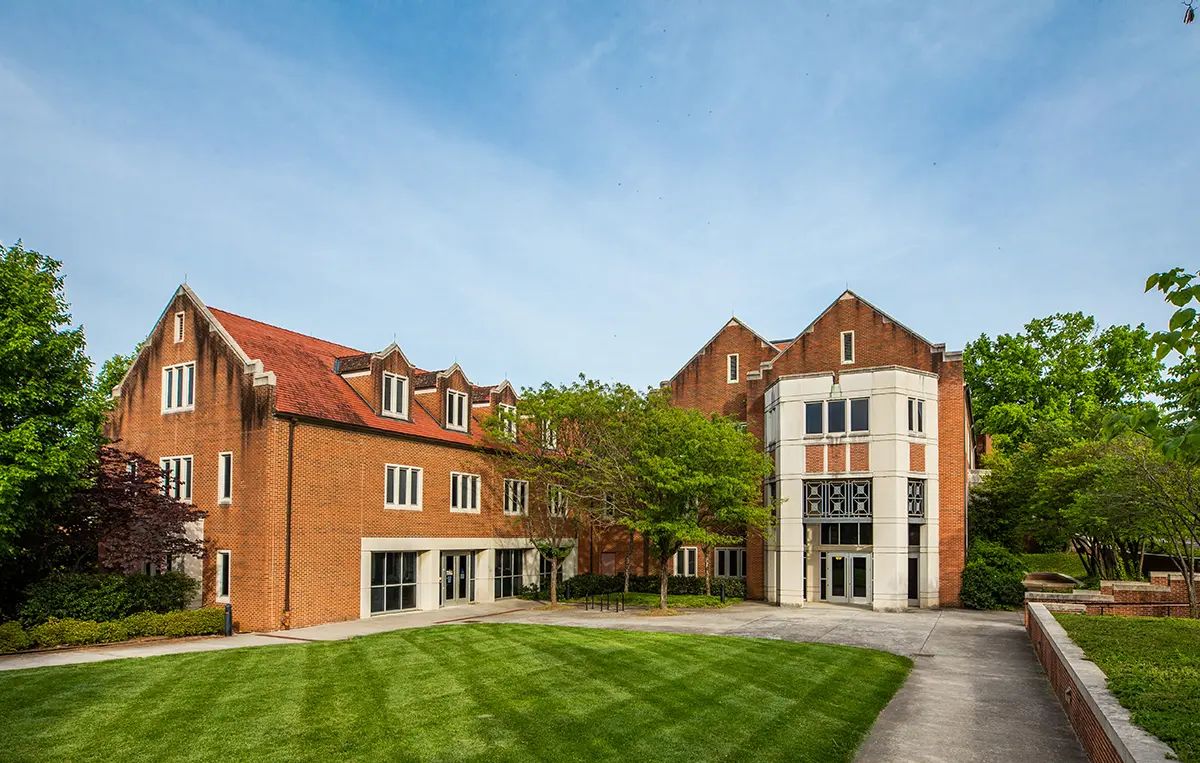
Exterior photo of the Claxton Education Building, home of the College of Emerging and Collaborative Studies. Photo by Steven Bridges/University of Tennessee
Exterior photo of the Claxton Education Building, home of the College of Emerging and Collaborative Studies. Photo by Steven Bridges/University of Tennessee
Higher education is at an inflection point. Shifting demographics, technological disruption, rising costs and questions about return on investment are converging to challenge the traditional model of the modern university. At the same time, industry leaders need a workforce equipped with skills that evolve at the same speed as technology.
Students and employers are asking higher education to adapt at a pace it was not designed to meet. The University of Tennessee, Knoxville (UTK) responded to this challenge by launching the College of Emerging and Collaborative Studies (CECS).
CECS is not only a new academic unit, it is a bold experiment in how higher education can operate more like a start-up—agile, collaborative and future-focused. Our mission is to serve as a campus-wide hub for academic innovation, breaking down siloes to develop future-ready curricula, preparing all learners not just to contribute to the workforce of tomorrow, but to lead it.
The Origin Story: Why CECS Was Created
In November 2022, UTK made a daring bet on reimagining higher education. I was appointed as the vice provost for academic affairs, with a charge to create a new college that enabled intercollegiate curriculum development and positioned higher education to prepare students for the emerging skill gaps in the workforce.
The task was clear. Students need skills that align with rapidly evolving industries such as AI and cybersecurity. Employers want graduates who can navigate uncertainty, lead with adaptability and master ever-changing technology. Meanwhile, universities face mounting pressure to deliver on the promise of a return on investment.
Our vision was to design a college that would:
- function as a hub for collaboration across disciplines
- prioritize experiential, hands-on and place-based learning
- develop programs in emerging and future-focused fields
- serve as an incubator for programs that keep higher education relevant and responsive
In short, CECS would operate as a start-up within a traditional university.
Building a College from the Ground Up
Designing the college required structural and programmatic innovation and a cultural shift. From its inception, CECS followed a campus-wide shared governance model, where faculty across UTK colleges worked together to develop and manage future-aligned, intercollegiate programs. To ensure participation and input from all colleges, CECS established the Leadership Advisory Board.
The advisory board comprises academic leaders from different colleges, who meet monthly to discuss topic selection and develop cross-disciplinary programs. CECS also holds an annual Campus Catalyst event that brings together faculty to brainstorm new ways to work together on curriculum development.
Within two years of its establishment, CECS launched bachelor of science degrees in applied AI, data science and innovative transdisciplinary studies, alongside minors and certificates that can be added to any major or stacked to create a custom degree. This model ensures that all learners, whether exploring new interests or pursuing full majors, can move from literacy to proficiency to expertise in emerging fields.
Four key principles around the learner needs have guided our curriculum design:
- Flexibility: CECS designs programs that are flexible to meet learner demands and fit into their academic plans. Students can take an exploratory course, such as AI 101, and then utilize electives to add a certificate or minor, declare a major or a double major.
- Stackability: CECS offers stackable certificates that give all learners the ability to add micro-credentials to their degree programs. These can also be stacked to build a customized degree.
- Agility in Action: CECS launched three degrees in less than a year—a timeline far shorter than traditional curriculum processes—by working with existing campus faculty as a central hub instead of building large new infrastructures. In two years, CECS has been able to expand to four degrees, eight minors and fifteen certificates.
- Access to Emerging Tech for All: Offering exploratory courses, such as CYBR 101—Introduction to Cybersecurity Concepts, DATA 101 and GAME 201—Introduction to Game Craft, is a cornerstone of the CECS curriculum.
CECS 101—Design Your Career, Design Your Degree is a signature course that utilizes design thinking to help students craft an educational journey that aligns with their unique interests and career aspirations. All CECS exploratory courses meet UTK’s general education requirements and enable students to build literacy on emerging topics while fulfilling their graduation requirements.
Lessons Learned for Higher Education Leaders
Our journey offers insights for others looking to lead institutional change.
- Start with the “why”: Innovation must be grounded in a clear mission and respond to well-defined needs. Not only explain your “why” clearly and frequently, but also ask “why” when roadblocks arise. Embracing change requires leaders to be curious and challenge the status quo.
- Build coalitions early and often: CECS would not exist without relationships nurtured across the university and with industry partners. Many of these relationships were developed and fostered well before the official launch of CECS and have been critical to the success of the college. Our campus partners shared their skepticism, challenges and vision for how we can equip learners for success. Our industry partners have offered curriculum guidance, experiential learning opportunities and letters of support in the curricular approval processes.
- Design for agility: With technology changing rapidly, we must accept the need for fluid structures that leverage collaboration. To meet the demands of the future, they need to allow for shifting focus without having to uproot people and investments.
- Expect resistance: A “start-up” college challenges long-held traditions. Some questioned whether this model implied that the practices that have been proven effective were now deemed insufficient. Others wondered if the CECS model was a hype that would not last. We welcomed that skepticism. It created conversations, helped create buy-in and taught us to evolve and adapt.
- Embrace imperfection: Waiting for the perfect model would have meant never starting. By piloting quickly and revising along the way, we’ve built a culture of experimentation that benefits both students and faculty.
- Pursue continuous improvement: The CECS campus-wide faculty committees continually review the curriculum to align with technological advancements, ensuring learners enter the workforce ready to make an impact. CECS regularly reassesses programs by gathering feedback from learners and industry partners to remain responsive, relevant and ahead of emerging needs.










Early Success Indicators—and What’s Next
Two years in, CECS has shown promising results. We increased majors nearly nine times from Fall 2024 to Fall 2025. Total course enrollment tripled from Fall 2023 to Fall 2025, with the number of students in AI courses growing 23 times and enrollment in our signature CECS 101 course rising sevenfold.
Beyond the numbers, CECS is demonstrating a new way of thinking in higher education—one that values agility, responsiveness and collaboration while keeping academic rigor and learner needs at heart. Our work affirms that this start-up model can thrive within the existing university environment.
Looking ahead, CECS will continue to incubate new programs, pilot innovative teaching models and remain a living laboratory for academic transformation. The challenge before higher education is clear: we must ensure learners are equipped for the future economy. To my colleagues across higher education, I pose this question: What experiments could you launch today to meet the future head-on?
Find out more about the College of Emerging and Collaborative Studies at the University of Tennessee, Knoxville.
This custom content is sponsored by the College of Emerging and Collaborative Studies and developed by Inside Higher Ed's sponsored content team. The editorial staff of Inside Higher Ed had no role in its creation.

 Built with Shorthand